
A full video transcript is available.
The Tactile Universe
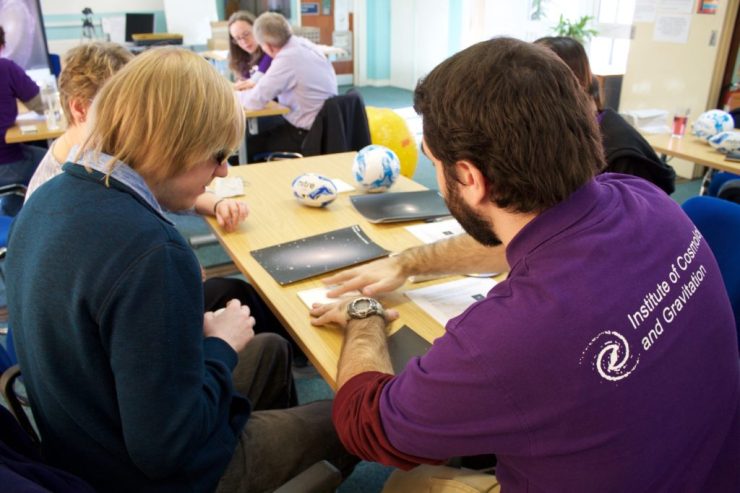
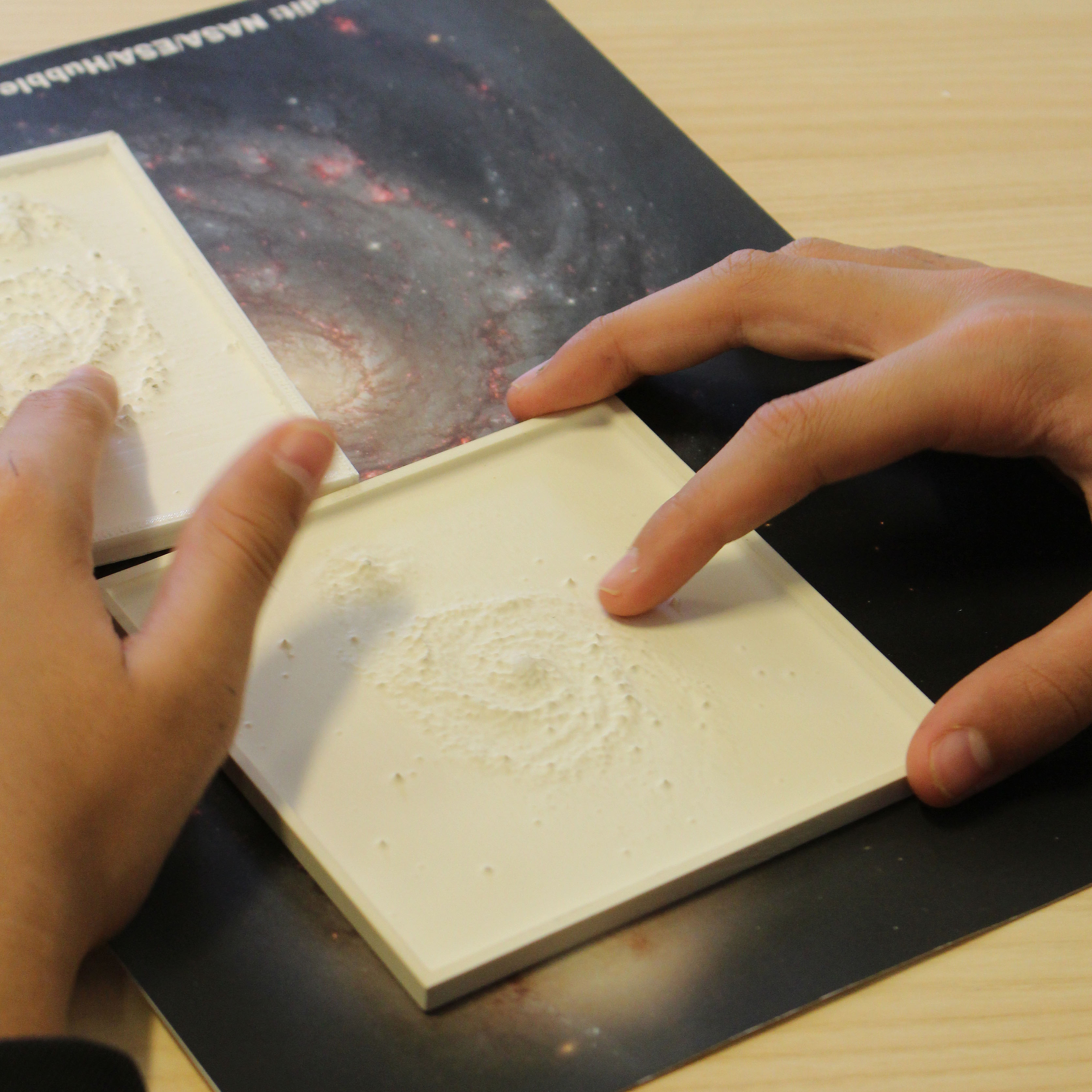
The Tactile Universe is an award-winning public engagement project at the University of Portsmouth’s Institute of Cosmology and Gravitation to engage the visually impaired (VI) community with our astrophysics research. We are creating 3D printed tactile images of galaxies and other astrophysical phenomena and objects which can be used in schools and at public events.
Current Status
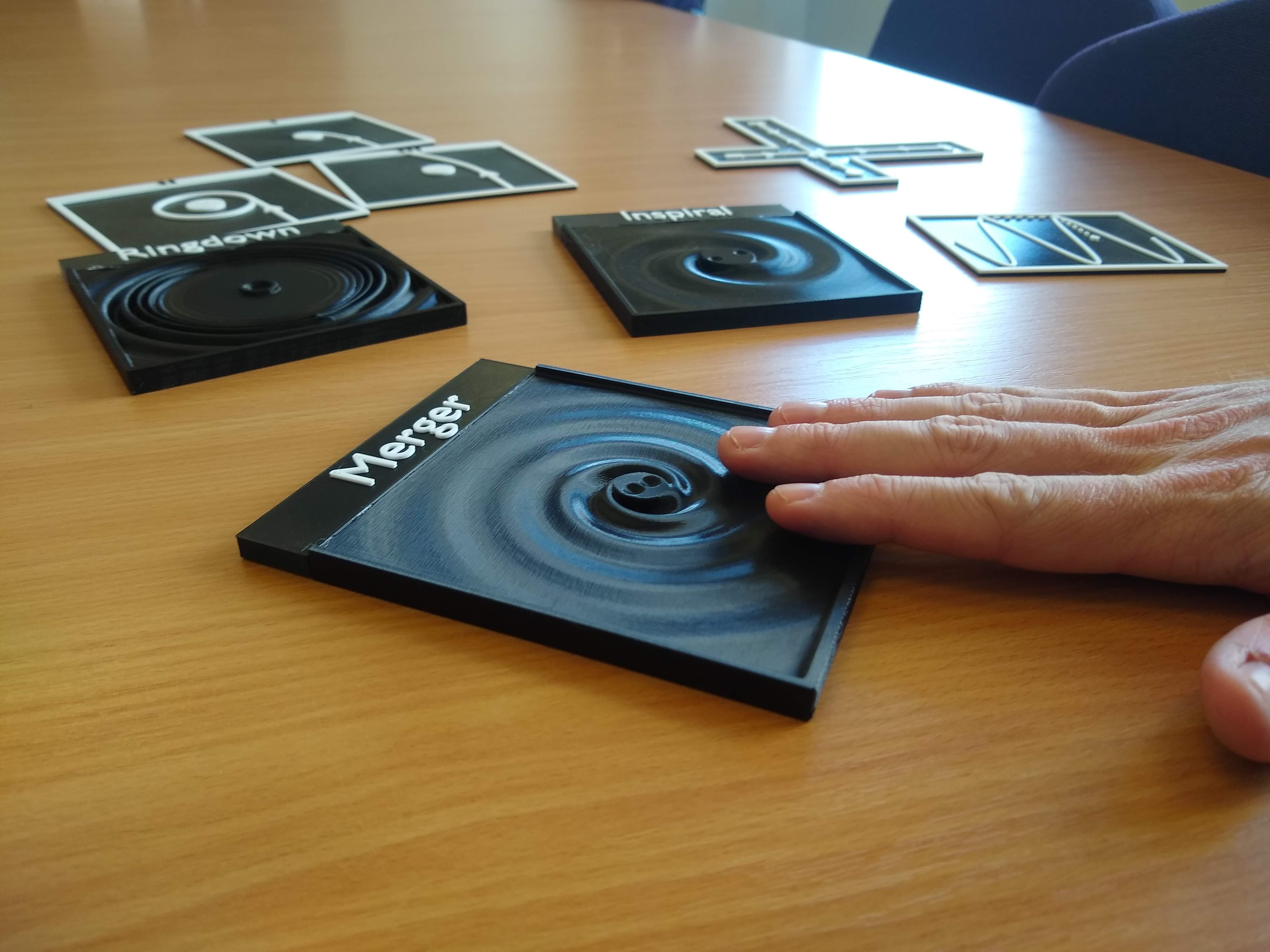
The current focus of the project is on engagement with young people, particularly those with vision impairments, through school visits and workshops. Incorporated into these workshops, we have created a set of versatile, VI-accessible resources for use in upper primary, lower secondary and upper secondary classroom (with pupils aged 9 – 16+). For pupils in upper primary, topics of these workshops include the solar system (focusing on scales, sizes and distances) and galaxies (covering our Milky Way as well as other galaxies, focusing on their unique shapes and colours). For pupils in lower secondary, we’ve created a more advanced galaxies workshop which focuses on galaxy shapes and colours, but digs a bit deeper into some of the physical processes that can change galaxies over time. Most recently, we’ve developed workshops for upper secondary pupils covering topics on the subject of gravitational waves (what produces them and how we detect them on Earth). These workshops are our first to incorporate sound alongside tactile resources.
If you want to organise to have a Tactile Universe workshop delivered at your school or organisation, want to use our resources yourself, or if you want to find out how you can get involved with the project in other ways, please don’t hesitate to get in touch with the team.
To find out how the project started, how we’ve grown and what we have achieved at various stages since our inception in 2016, please continue reading below.
Pilot Project (2016)
We started as an initial six month pilot project funded by the South East Physics Network from mid 2016 to January 2017. For this pilot, we developed and tested the first iteration of our 3D printed tactile images of galaxies, which were used in a public event for the VI community in Portsmouth on the 14th January 2017. At this event, attendees were able to explore the different shapes of galaxies using a set of the 3D printed galaxies. You can find out more about the pilot by reading our A&G article.
In 2017, we shifted our focus to working with schools. With the help and input of local specialist teachers and VI students, we further refined our tactile resources and created schools workshops on topics around the Solar System and Galaxies centred on these resources suitable for pupils in upper primary and lower secondary.
Nucleus Award (2018 – 2020)
Beginning in 2018, with support from STFC through a Nucleus Award, we expanded the reach and impact of the project throughout the UK. In summer 2018 we made freely available our 3D printing files for the tactile galaxy images, plus supporting materials (like lesson plans, best practice guides and 3D printing FAQs) so that anybody could access and use these. These resources are still available and can be found on the models page of this website.
In the 2018/19 school year we ran training sessions in Edinburgh, Manchester, Birmingham, London and Portsmouth, so that researchers, educators, science communicators, outreach professionals and any other interested parties could learn how to use our resources. To allow our trainees to engage their local communities with our project, we sent out 20 resource kits containing sets of bespoke clear resin cast versions of our tactile galaxy images along with all of the other resources required to run our solar system and galaxies workshops.
In early 2020 the Portsmouth team ran our primary and secondary school workshops at remote schools in Cornwall for VI pupils and their sighted classmates.
Legacy Award (2020 – 2023)
In 2020 with further support from STFC through a Legacy Award we embarked on the most recent phase of the project. Working with our own gravitational wave researchers, other researchers in Wales, England and Scotland, as well as local VI educators and VI students we created additional educational resources suitable for students in upper secondary. Focusing on the science of gravitational waves, these new workshops aim to support students’ understanding of concepts around mass, density, gravity and waves while covering some of the exciting science behind how gravitational waves are produced, and some of the amazing technology and techniques that have been developed to detect them. Unlike our previous workshops, these new workshops use audio elements alongside tactile resources to provide an even more multimodal experience.
In late 2023 we ran training workshops for these new resources and classroom activities with gravitational wave research groups in Cardiff, Birmingham and Glasgow. We also provided each research group with a kit containing all of our new resources for them to use in their own local delivery.
To find out more about this phase of the project, you can read this article published in Issue 24 of LIGO Magazine.
Finally, during this award period, we also ran an additional galaxy and solar system resource training workshop in Cardiff, supplying additional resource kits to some of our new trainees to help them in their future delivery of the project across Wales.
 Tactile Universe